

Free Parking Is The Problem...
Policy Brief

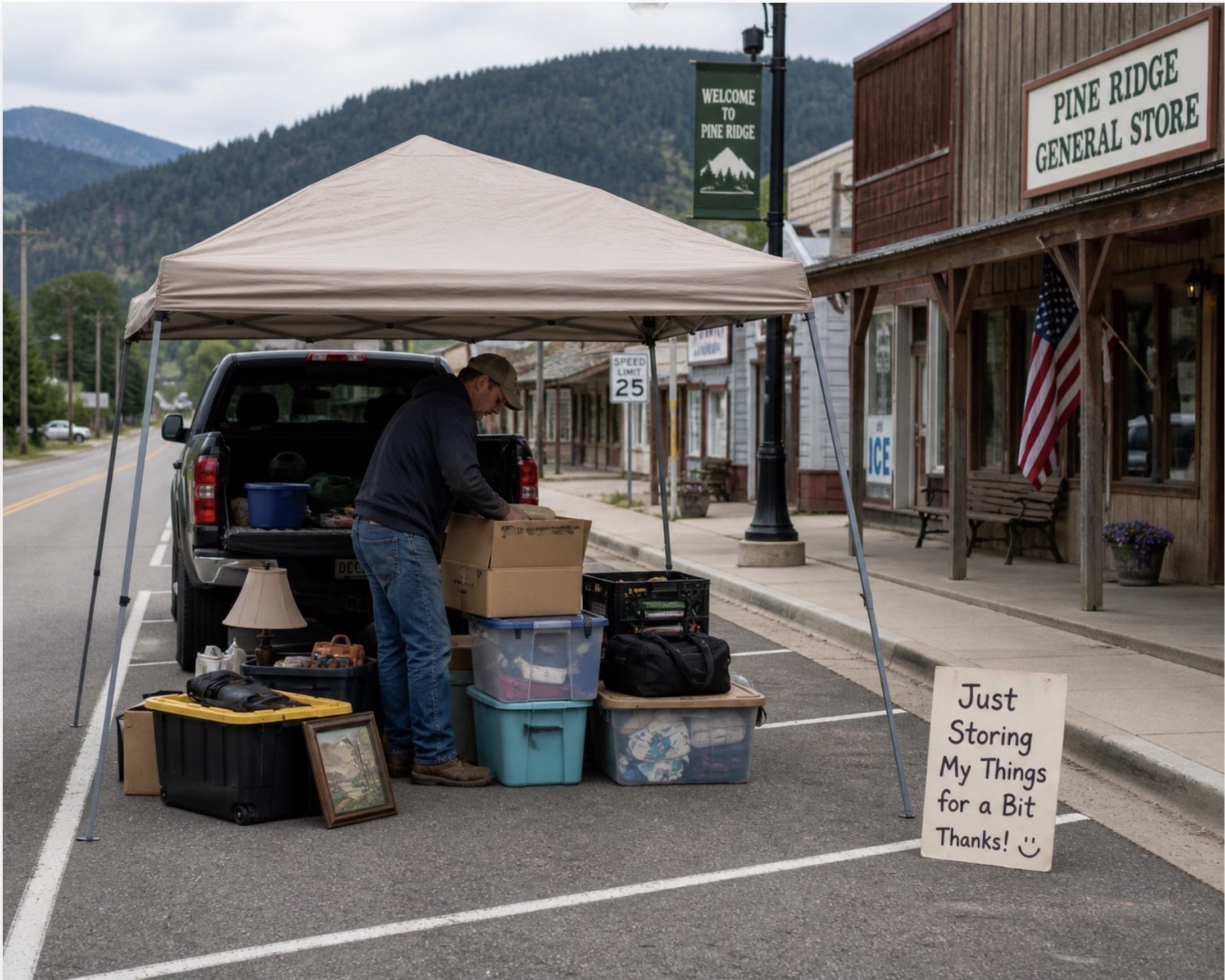
We find it absurd to think that someone should be allowed to freely store their private possessions on the street as depicted above. In fact, it would be considered outrageous to think people would demand that our streets become their own personal storage facilities for lights, bins, or spare beds, and yet we believe that the street is rightfully ours to store our car for free of charge. If Windham wants to really solve its on-street parking problem, the answer isn’t a parking mandate that creates wasted space, costing all customers more at the cash register with parking mandates. The answer is creating dynamic pricing for our street parking when it matters most. How many times have you seen vehicles parked in our community on the street, taking up space for days on end? This is the logical outcome of Free Parking. If parking in front of your favorite store or location on Main Street is so cheap that it makes sense to leave your vehicle for extended periods, the public good that is parking will be consumed all too quickly and for far longer than is possibly necessary.
So, that is why I’m advocating parking on Main Street starts to be priced when it matters most to ensure that more parking is available for longer periods of time. The concept is not new; dynamic pricing was first suggested in this manner in a paper in 1954. However, having the proper equipment stopped this dead in its tracks. However, with today’s ability to digitally control parking meters, this type of dynamic pricing is not only possible, but it is also actually beneficial to the public in that it allocates public parking in a fair and equitable way across the most demanding times in our community.
My basic assumption was that 200 spaces exist on Main Street as On-Street parking. This is based on a Friday through Sunday time frame. All of the assumptions can be seen clearly in the next table:
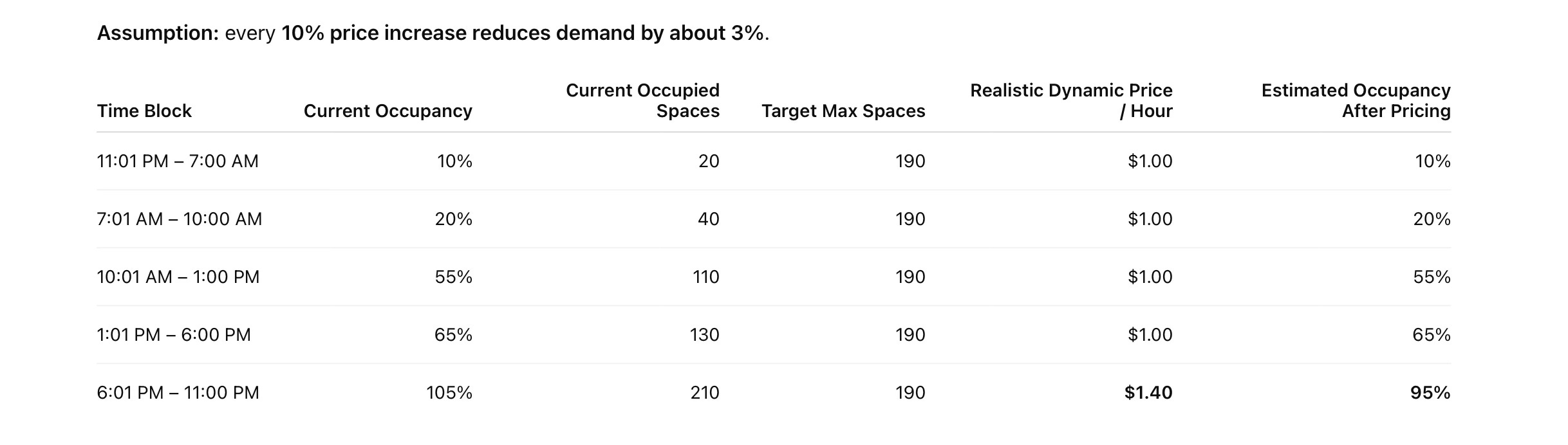
I calculated that between the hours of 6:01 pm and 11:00 pm, we would have the highest amount of parking demand due to the peak hours for restaurants in the community. Since the goal is to maintain 95% occupancy of all spaces in the model. This requires us to shift the demand as the price increases. So in this model, we placed a 3% reduction in demand as price increases at a 10% rate. So, a $1.40 per hour rate allowed the 105% peak demand between 6:01 pm and 11:00 pm to be reduced to the targeted 95% required to ensure no one is cruising or fighting for parking.
Let’s expand the model to include some more realistic possibilities of occupancy rates in Windham during weekends. Let’s assume the busiest times of the day are 6 pm to 11 pm, and they also have the least elasticity in demand. Meaning that the goal of achieving 95% occupancy is with a 3% decrease in parking demand, then it will require a 20% increase in price instead of 10% that is required before 6 pm. This makes sense intuitively since 6 pm to 11 pm is the prime dinner hour on our main street. People are far more likely to spend extra to ensure they can keep their curbside parking. So, we increase the price to $3.67 per hour, as can be seen in the next table.
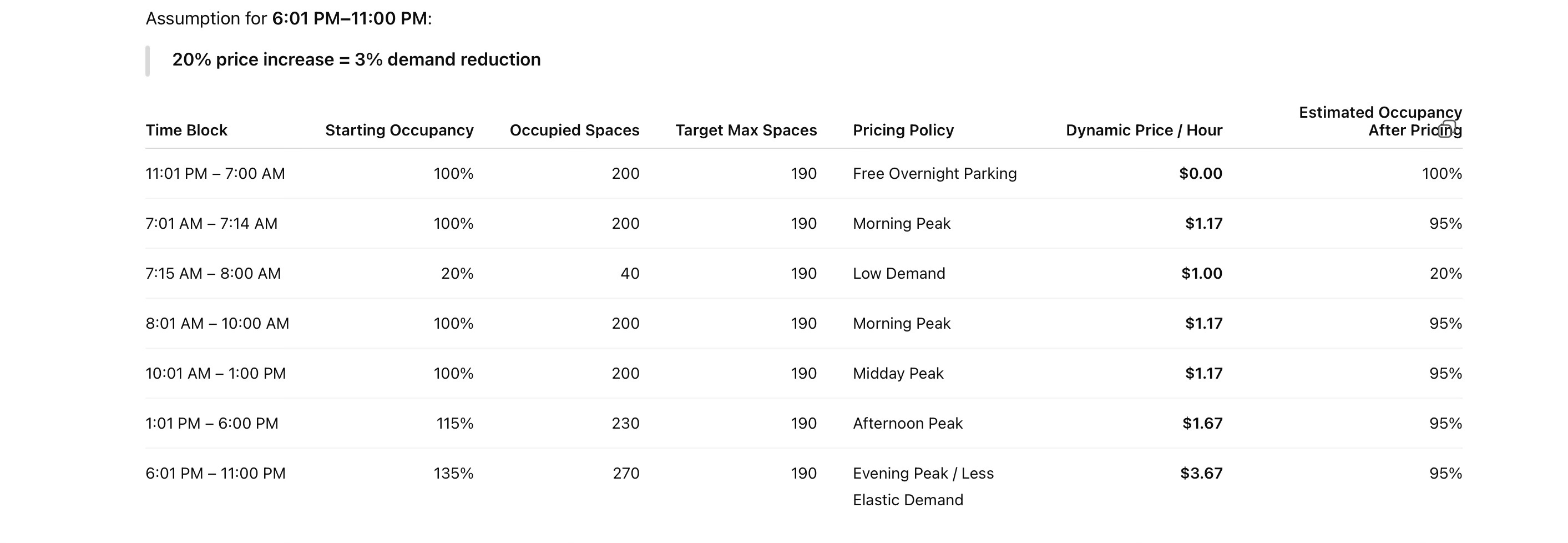
As you can see, the model now looks more like what you expect from parking- you have a morning peak when people are getting things like coffee, pastries, going out to the post office, and getting themselves things for the day. That ends. And then what should happen is another peak when you have people coming into town, including tourists, workers, and people just out and about. This next table shows that, and we’ve created a breakfast crowd between 8:01 and 10:00 am that is slightly less elastic in their demand for parking and will suffer a 15% increse in price to ensure their curbside parking. This table shows the model.
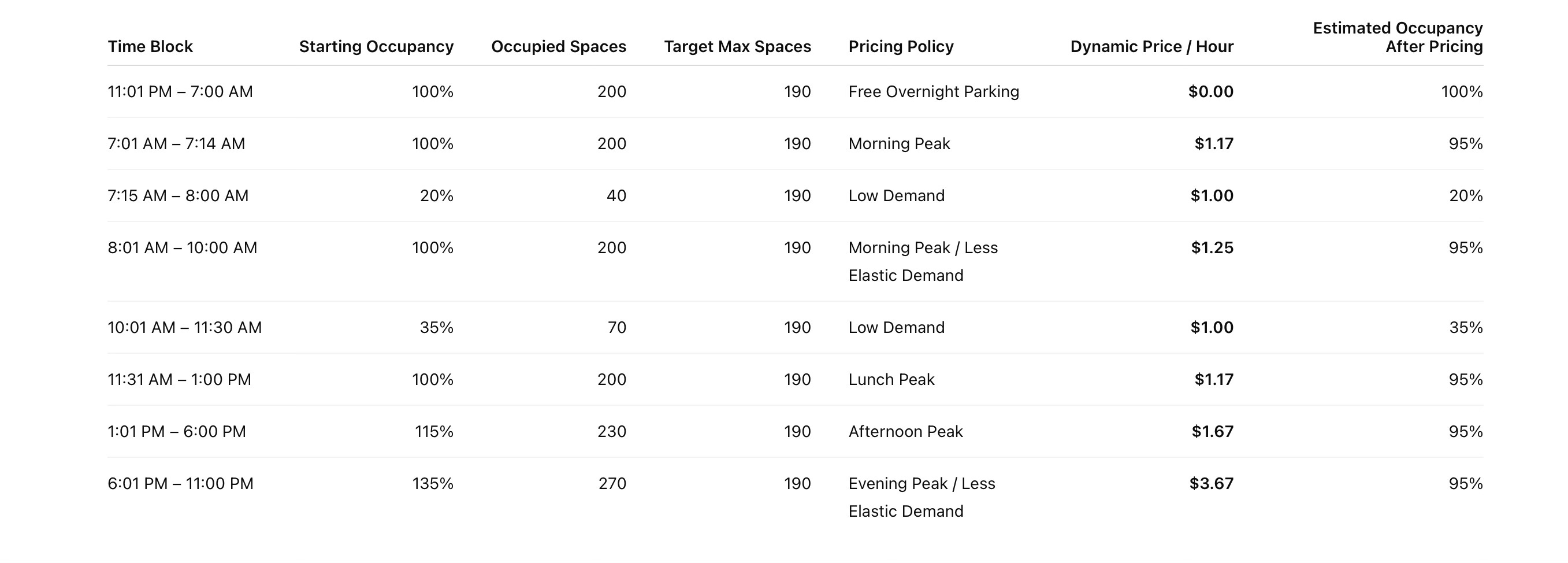
What we’ve effectively fixed is the issue with demand exceeding the supply of the fixed quantity of curbside parking spaces. We’ve left the community the freedom to use the public parking lots if they so desire that are still free. This will push those who, as George Costanza, Jr (character from Seinfeld) said so aptly: “You don't understand. A garage, I can't even pull in there. It's like going to a prostitute. Why should I pay, when if I apply myself, maybe I could get it for free?” Those who are vehemently opposed to paying for parking will obviously opt for the extra walking distance that our public parking offers them, while keeping the convenience of the curbside parking absolutely in line with the correct pricing to allocate the proper amount of demanded parking spaces.
Then, for the fun of it, I created a model that would estimate the revenue generate the daily, weekly, monthly, and annual incomes from this dynamic pricing. I also calculated that the pricing would only really be required for Friday through Sunday. During the rest of the Week the parking meters are free. I estimated 1,500 cars daily for those three days. And as you can see in the next table, that is an impressive amount of revenue we could generate.
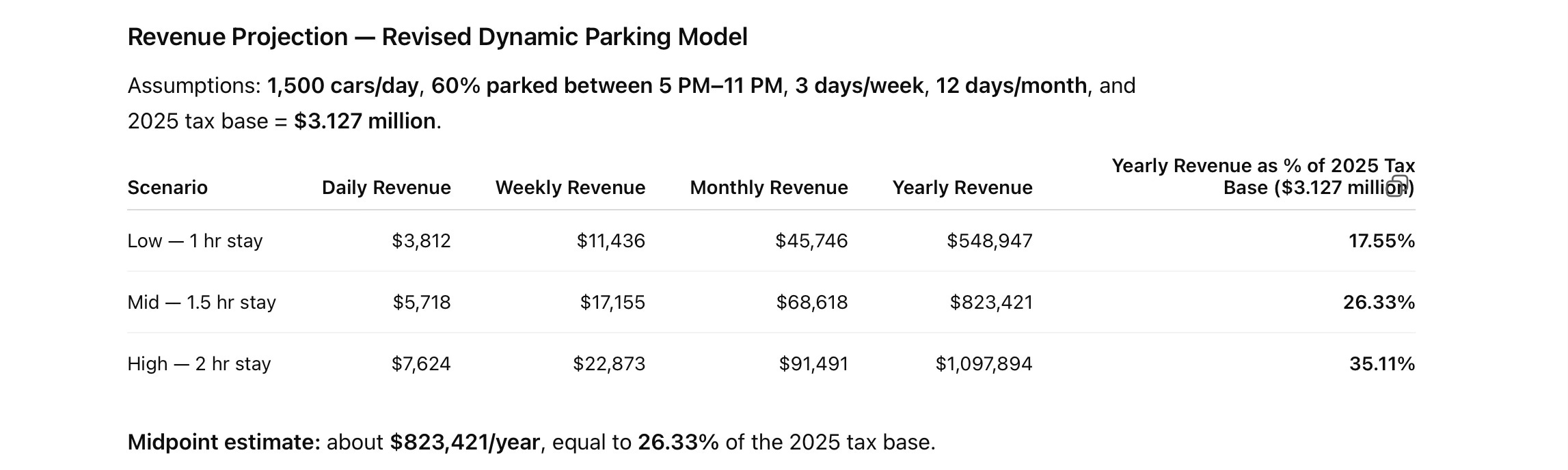
As you can see, during our peak periods, tourism, say between November and March, and again from late May to mid-October, we can achieve these numbers of cars on our main street. Perhaps even more cars are present. We would have to do a real study to understand parking habits in our community— but the numbers are clear that a properly priced parking space at the correct times of day to match the demand will ensure spaces are always available and that the community maximizes its own revenue source. Most likely, the town would have to share this revenue with the state. But even a 50/50 split would give Windham at any of the three scenario scales well over $100,000 in extra revenue in our coffers. It would also eliminate the burden of costs for needless parking on our Main Street. It would streamline parking requirements. And create equitable usage of a public good during periods of highest demand.
While everyone loves free parking, the fact is that it is abused by those who wish to use it for long-term storage, while others are left with no spaces. The only possible way to ensure that Windham’s curbside parking is properly allocated as a public good is to utilize the natural features of pricing to make the price of parking more in line with the supply present in the community. Now, many will complain, but this solution solves Windham’s parking issues, reduces cost burdens on everyone since “free and open off-street public parking” will still exist and should be expanded.
Obviously, the model is designed to show that dynamic pricing would work. We have to have studies of Windham’s actual parking demand to understand exactly the type of pricing structures we want to implement for maximum effectiveness. This type of parking has proven effective in reducing congestion in cities and will do the same in our community, too. The question we have to ask ourselves is, why aren’t we implementing it already?
The issue of event parking is not solved with curbside parking or parking mandates for businesses. Event parking will be solved by using Shuttle buses and extra connectivity based on alternative modes of transportation. That means creating new sidewalks and bike lanes in our community.