
Socializing The Risks. Privatizing The Gains...
The Implications Of A Captured Mountain Top.

Over the last 50-plus years, a popular theory in modern governance and economics has taken hold known as Public Choice Theory, developed in the late 1970s by James M. Buchanan, an economist and professor at George Mason University. George Mason University is known for its strong libertarian positions on government and economics, with connections to Koch Industries through Richard Fink, an academic and former board member of the Charles Koch Foundation, among other right-wing libertarian think tanks. Richard Fink founded the Mercatus Center at George Mason University in 1980, further expanding the influence of Austrian economic theory.
The Mercatus Center focuses on Austrian economics as filtered through the intellectual tradition of the University of Chicago, particularly the work of F. A. Hayek and Ludwig von Mises. This tradition influenced Nobel Prize-winning economists such as Milton Friedman, Arnold Harberger, and Larry Sjaastad, who would later help educate the so-called “Chicago Boys,” the Chilean free-market economists who provided much of the intellectual foundation for the market reforms implemented during Augusto Pinochet’s military dictatorship (1973–1990).
In this revolutionary period of economic upheaval during the late 1960s and early 1970s, James M. Buchanan entered the fray. Buchanan, who was every bit the acolyte of F. A. Hayek and Ludwig von Mises as his better-known and more publicly influential counterpart, Milton Friedman, began developing the theory of “Public Choice.” In its most succinct formulation, the theory essentially argues two things: (1) governments are inefficient and ineffective at creating value in the free market, and (2) governments do more harm than good because they are not only inefficient and ineffective, but they also respond to the whims of voters rather than the market.
Ultimately, these ideas led to the type of rhetoric embodied by Milton Friedman, who once said, “If you put the federal government in charge of the Sahara Desert, in five years there’d be a shortage of sand.” Or, as President Ronald Reagan often remarked during his campaigns, “The nine most terrifying words in the English language are: ‘I’m from the Government, and I’m here to help.’”
These attitudes, cultivated by a deeply rooted belief that value creation is the exclusive domain of the entrepreneurial class, are nothing new. Their earliest and strongest formulations can be traced back to David Ricardo (1772–1823), the English businessman, economist, and later politician. Ricardo viewed labor as the source of value, but he also regarded the capitalist class as occupying the highest position within the productive process. In his great treatise, On the Principles of Political Economy and Taxation (1817), he outlines the central role that capitalists play within his labor theory of value.
This attitude—that business is exclusively the domain of the private sector—creates a paradox in free-market thinking that both Karl Marx (Das Kapital, Vols. I–III) and later the Hungarian lawyer and economic historian Karl Polanyi(1886–1964) pointed out in his highly influential book, The Great Transformation (1944). Governments are not merely passive arbiters of free markets, designed only to resolve juridical disputes or ensure that the basic infrastructure exists to promote the free market. Rather, they actively create and shape the free market itself. They are active forces in determining how markets develop and create value by establishing the very conditions in which markets come into existence.
Of course, Polanyi’s work has many fierce detractors for a variety of reasons and from across the ideological spectrum. Ultimately, however, the enduring value of his work lies in recognizing that markets are not simply a part of nature; they are, in fact, emergent properties of broader social conditions, in which the influence of local government is critical in establishing the conditions that allow markets to develop.
However, modern neoclassical value theory is based on a fundamental shift in focus. Instead of relying on the labor theory of value, which underpinned the classical models of Ricardo, Smith (The Wealth of Nations), and Marx, it instead focuses on the price of the commodity itself as the source of value—a subjective measure developed to create an all-encompassing concept of value in economics.
Ultimately, this subjective approach, which places value in the price of a commodity (whether a product or a service), represents a departure from the quantifiable and concrete concept of labor as the basis of value. Instead, it returns value to a subjective framework based on the preferences and perceptions of those participating in the market. In this view, the nature of value is seen as lying outside the scope of government and even outside the labor that produces the commodity itself. Value becomes a subjective feature of market pressures rather than something determined by the productive forces that create the market.
In this sense, we have returned to the pre-classical notions of value first formulated during the mid-seventeenth century, at the height of the mercantilist period, when the determination of value was viewed largely as a matter of convention by those who possessed the authority to define it. Within the mercantilist system, the ultimate source of value was believed to reside in the stock of intrinsically valuable precious metals, which in turn determined the prices of all things, including the labor of miners unearthing these treasures and the wealth of Europe’s treasuries minting these vast fortunes.
In this respect, our modern conception of value represents a return to this pre-modern understanding of value, as Mariana Mazzucato argues in her excellent work, The Value of Everything.
And like these Mercantilists our modern Public Choice theorists are simply drawing abratirary boundaries around value generators and value extractors (economic rents). A theory like Public Choice Theory with its necesary felty to the Enterpenuerial Class means that it cannot accept the fact that Governments play a fundamental part in the creation of markets and molding the forces that create their more emergent properties from their directly related properties. Instead of being just neutral arbiters of a market that Governments respresent in Public Choice Theory better leaving Communities to outsource the business operations to the private sector.
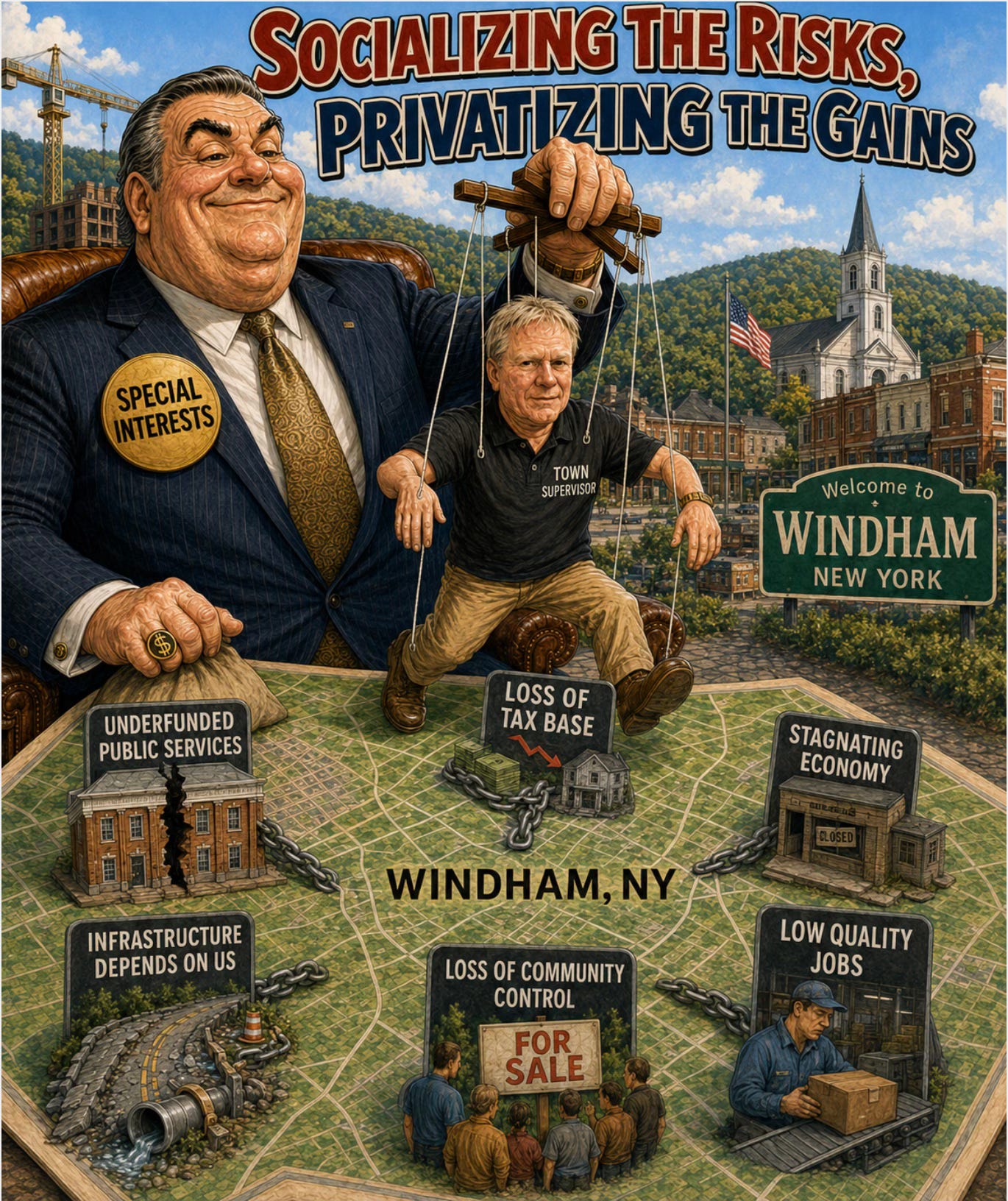
The concept that governments are unable to operate effectively or efficiently is more myth than reality. During World War II, for example, the United States effectively operated under a government-controlled economy. The government set production quotas for everything from guns to butter (I know this is the classic example used in economics texts, but it seemed to fit perfectly in this case). In the case of the recent Downtown Revitalization Initiative in Tannersville, we can see how the process of socializing the risks while privatizing the gains is in full swing.
One of the clearest examples is the RUPCO, Inc. workforce housing project, which represents $2.5 million in grant funding being shifted to a nonprofit corporation. Now, some might believe that I think nonprofits are the problem. They are not. Nor do I believe that governments cannot work through public-private partnerships. Neither of those claims would be true, as I advocate a radically different type of partnership between local government and the private sector (i.e., renters and potential homeowners) through the creation of a multi-stakeholder housing cooperative. In that model, homeowners, renters, and the local government each share an equal stake in the equitable governance of the project. By contrast, RUPCO, Inc. is the sole owner of the equity in the current project. Once it has paid off its bank loan, RUPCO owns the housing, lock, stock, and barrel, as the saying goes, and will administer it using its own employees.
All of the rental income generated over the lifetime of the housing units will flow to RUPCO, paying salaries and helping to finance whatever project the organization undertakes next. What it will not do is create long-term economic growth in the community of Tannersville. Tannersville will not see an increase in middle-class jobs from a housing development corporation. Nor will it require the expansion of local government capacity to oversee future housing developments and create additional growth on the Mountain Top. Instead, many of the gains that could have been realized through well-paying local jobs for architects, engineers, and office staff will instead be concentrated in Kingston, New York, not Tannersville. What Tannersville will receive from the project are two jobs ( 1-full time and 1 part-time) within the housing development itself rather than a locally staffed office of skilled professionals whose work would contribute to the long-term well-being of the community.
The problem here is that the community lacks the equitable stake it deserves in the collective process of value generation that government is helping to create. Any good venture capitalist (VC), or investor of any type, would ask the question: What is the return on the investment? In the case of the housing project that Tannersville is undertaking, the question is whether the 60 induced jobs are truly enough for the community. What happens if those jobs turn out to be lower-paying service or retail positions? It turns out that the quality of employment matters just as much as the quantity.
The answers we’re getting suggest that the Village of Tannersville is not receiving the maximum return on its investment. In fact, the Village will have to wait a significant period of time before realizing the full tax benefits because it is using a Payment in Lieu of Taxes (PILOT) program to reduce the tax burden and increase the return on RUPCO’s investment. Typically, these programs last 20 to 25 years, reducing payments that would otherwise go toward county, school, and town property taxes. So the question becomes: What sort of equity stake should Tannersville have received in this program?
The answer is simply an equity stake that provides strong local employment across a broad range of occupations—from white-collar to blue-collar jobs—a meaningful share in the profits generated from day one, and the ability to ensure that the program grows alongside the needs of the community. The only way to guarantee these conditions is to create a different model for how public-private partnerships operate in the first place. Perhaps the solution is to create a model in which housing is treated not as a commodity but as a public good.
Making Value in a Public Good
Let’s assume that instead of hiring RUPCO, Inc. to manage and build the housing project, Tannersville—or any other community—decided to establish its own community-owned housing cooperative authority to develop long-term workforce housing. Let’s also assume that our hypothetical town, which I will call “Can-Do-Ville,” embraces the challenge of owning and operating its own workforce housing development.
The town has a Main Street with four blighted and vacant buildings sitting on 1.2-acre lots that it already owns through tax foreclosures. Instead of auctioning the properties to recover the unpaid taxes, the town decides to construct four mixed-use buildings, each containing 25 apartments and 10 commercial units on the ground floor. Each apartment is a two-bedroom, 1,080-square-foot unit designed to house a family of two to four people, based on a household income assumption of $83,440 per year for a two-income family in Greene County, according to the statistical data provided by Hudson Valley Pattern for Progress.
To ensure long-term affordability, housing costs must not exceed 30% of a household’s gross income. In fact, as you will see in the table below, both the rental and homeownership models provide substantially lower housing costs for families.
Housing Costs for Renters:
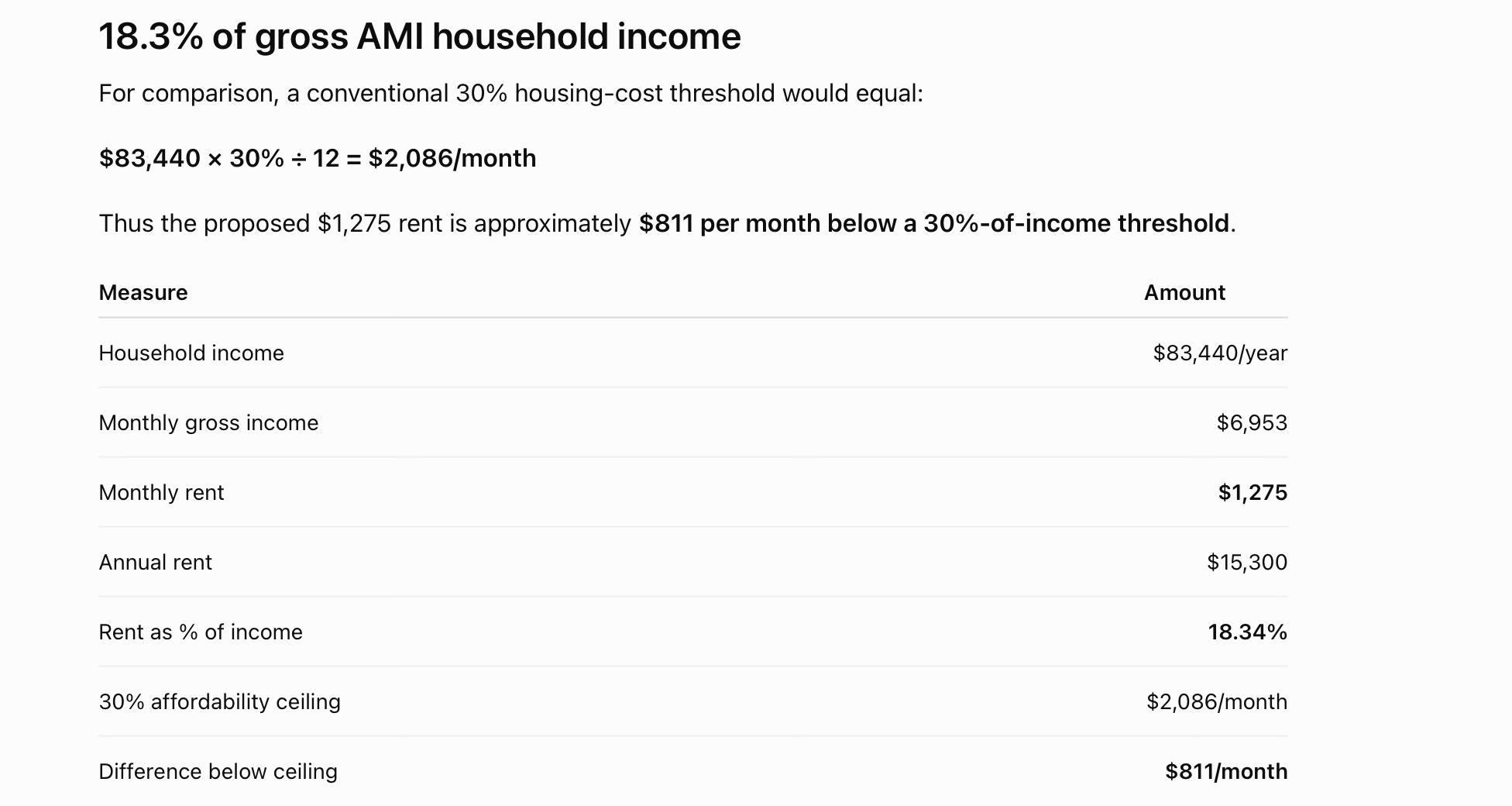
This shows that a renter earning 100% of the Greene County, New York, Area Median Income (AMI), as reported by Hudson Valley Pattern for Progress, would be paying approximately $811 per month less for housing than the traditional recommendation of spending 30% of one’s income on housing. That translates into $811 in additional disposable income each month at the fingertips of families with children. It means more opportunities to invest in their own futures through stocks, bonds, and other securities, while also increasing discretionary spending on local activities such as entertainment, dining, and gifts. In short, it means more money available to support the community’s long-term growth.
Now, let’s look at those who decide they want to purchase a home instead of renting—they wish to build a little equity of their own.
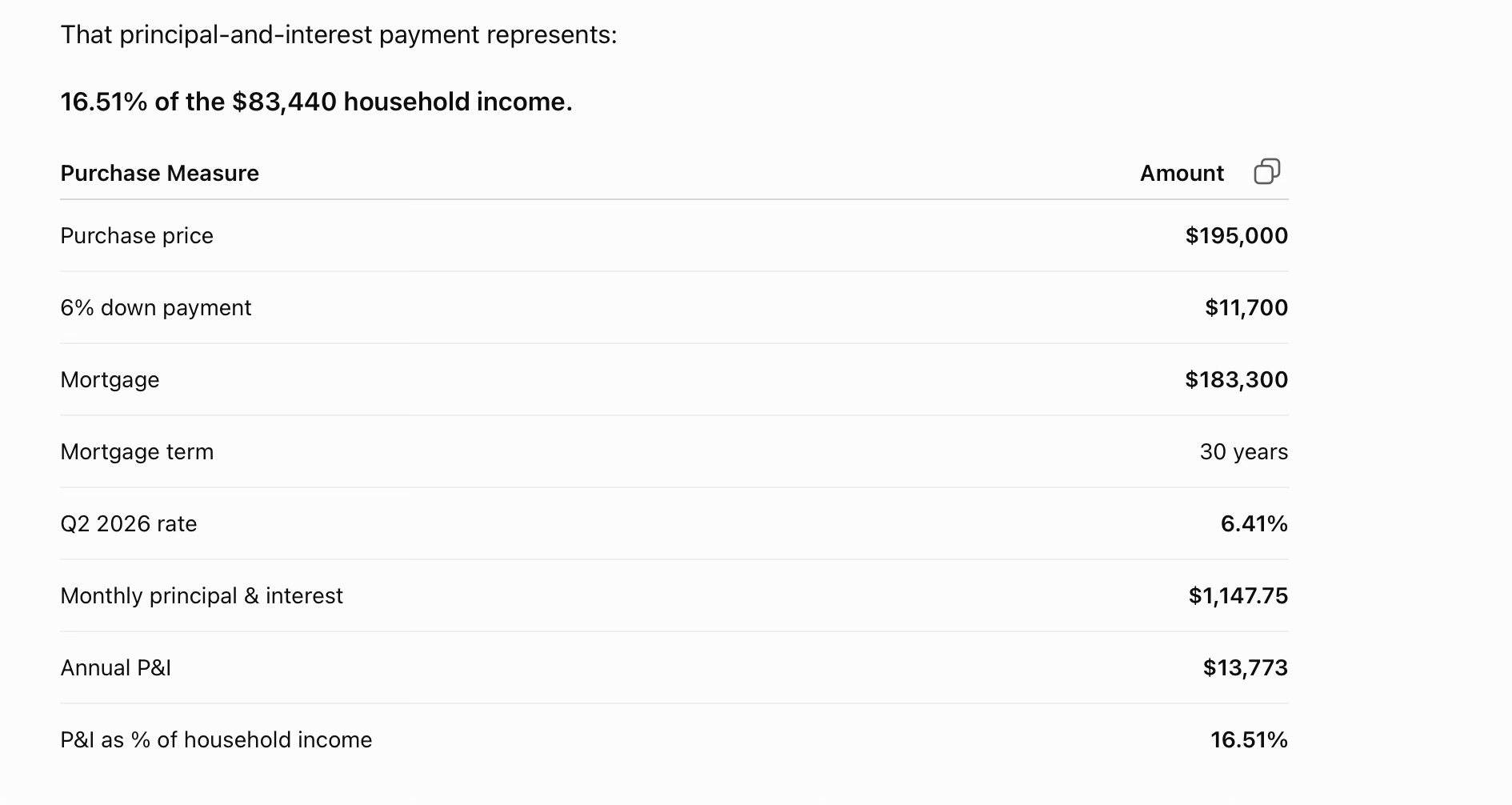
Now, with a modest 6% down payment and a purchase price of only $195,000 for a 1,080-square-foot apartment—equivalent to roughly $180.56 per square foot—we have an affordable home that provides families with an equity stake in their future. At current mortgage rates of 6.41%, the monthly mortgage payment would be only $1,147.75, representing less than 17% of the household's monthly income. This results in a lower monthly housing cost than the rental model. As part of the cooperative, homeowners would also pay a modest annual fee of $1,200 (or $100 per month) in cooperative dues. These fees would help cover expenses such as the salary of the building supervisor, property management, maintenance, and other shared operating costs.
The Cost of Construction:
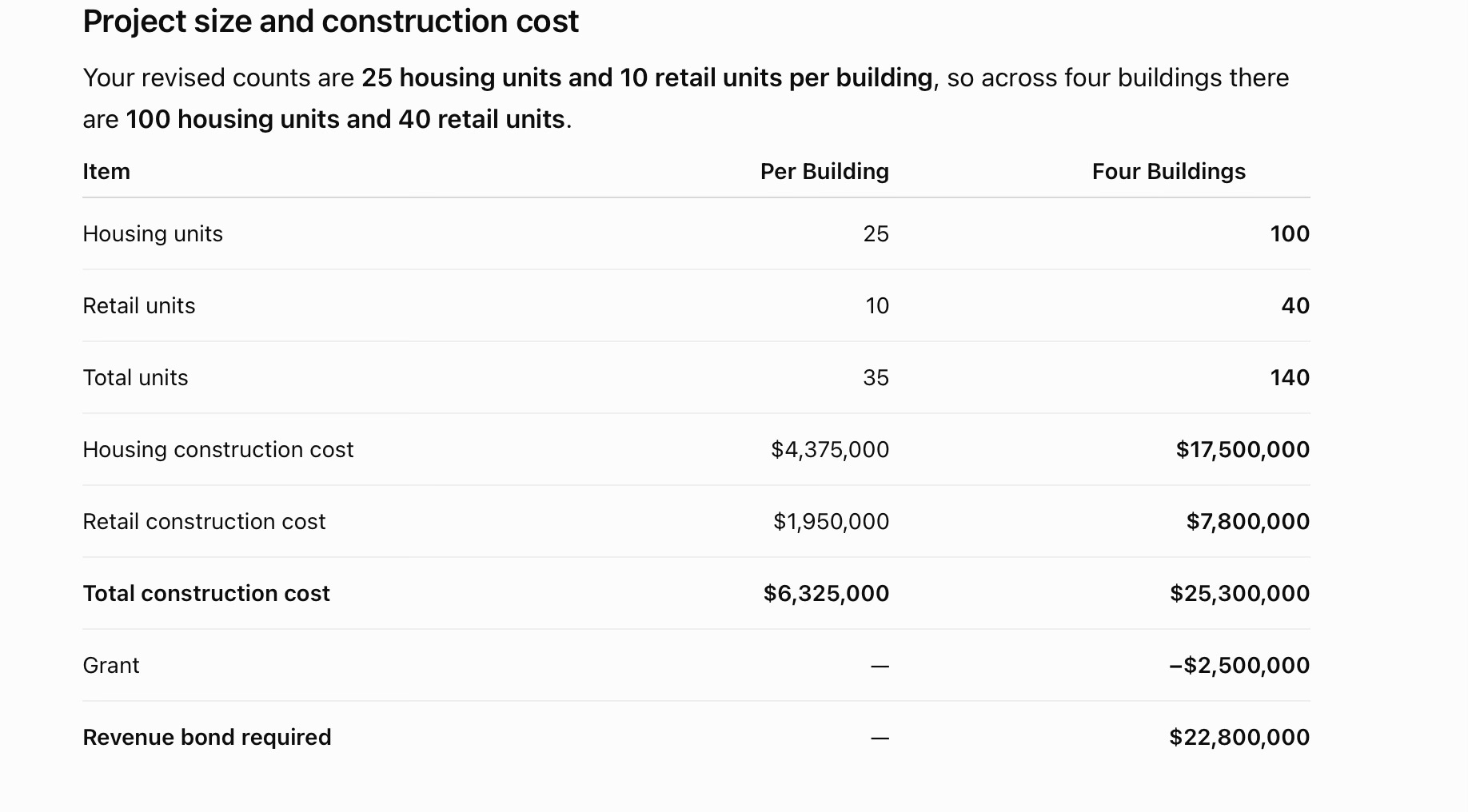
Utilizing estimates from the building industry, I arrived at a total construction cost of $6.325 million per building. We did not factor in land acquisition costs because the Town of Can-Do-Ville already owns the properties in question. While this scenario is possible, it is not always typical. However, because we want this hypothetical model to be analogous to the real-world example of Tannersville, which received land from the county at a very low cost (and possibly at no cost), we will assume that our hypothetical community is in a similar position.
This project comes very close to the $30.211 million that RUPCO is projecting for its construction project of 60 housing units spread across three three-story buildings. I have added a fourth story to each building to incorporate commercial space, thereby maximizing the total economic output of each structure. I have also reduced the costs of design and permitting by utilizing in-house designs prepared by employees of the Town of Can-Do-Ville rather than hiring outside firms, thereby keeping more money within the local community.
Furthermore, by relying on the town’s own staff, we reduce permitting costs and minimize delays in the development process. We also create the opportunity to use additional grant funding to study both the economic and environmental impacts of development—funds that would otherwise be spent on outside consultants. In this model, those functions are consolidated within the operating capacity of the local government, allowing grant funding to support research into broader issues that affect the entire community rather than being limited to a single development project.
How the equity builds:
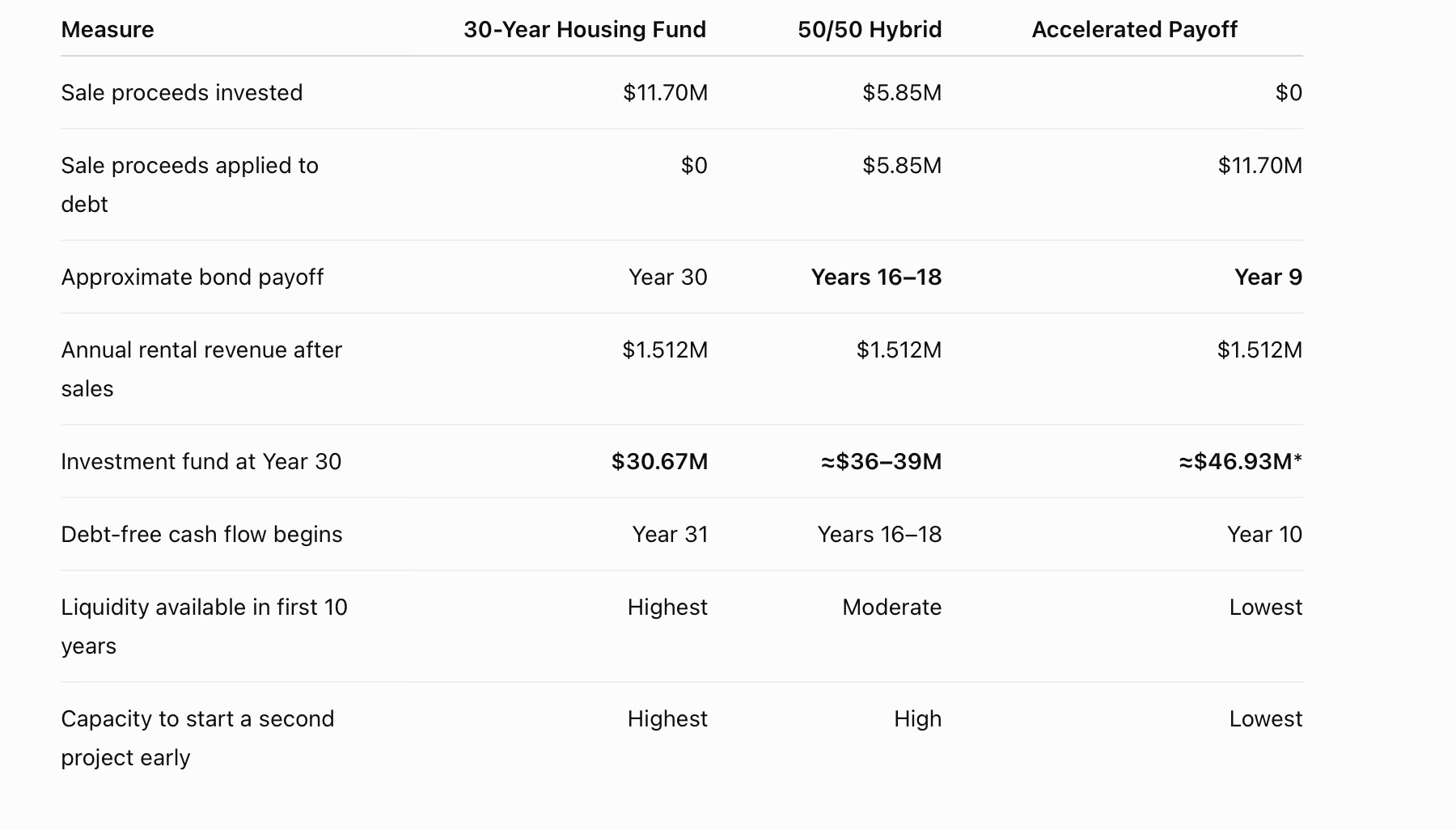
The housing model we’ve created contains two separate revenue sources: (1) the sale of 60 apartments to private owners, and (2) the retention of 40 housing units and 40 commercial units by the Housing Cooperative Authority, which would remain community-owned and serve as a permanent rental revenue stream. Over time, the community could also repurchase housing units from private owners to increase its stock of rental housing or stabilize the housing market as needed, ensuring that prices for these units remain relatively stable.
By giving community members the opportunity to own their own apartments, however, we also help foster long-term generational wealth while simultaneously creating the financial resources needed to continually expand the program.
In the model shown above, I used three different assumptions:
Thirty-Year Housing Fund Growth: All proceeds from apartment sales are immediately invested in safe interest-bearing securities earning 3.5% annually—roughly the long-term average return for certificates of deposit (CDs) or U.S. Treasury securities—to maximize the long-term growth of the Housing Fund.
50/50 Hybrid Model: Fifty percent of all revenue generated from apartment sales is used to offset the initial construction costs, while the remaining 50% is invested in safe securities earning 3.5% annual interest.
Accelerated Payoff Model: The most aggressive approach, in which the initial construction costs are paid off over a relatively short nine-year period. Once the construction debt has been retired, all subsequent revenue is directed toward building the Housing Fund.
While each strategy has its strengths and weaknesses, they illustrate a much more important point in this broader argument: communities that outsource the development of resources such as workforce housing are not merely offloading the perceived costs of management. They are also offloading the long-term equity gains that communities like Tannersville and Windham cannot afford to lose if they hope to achieve sustainable long-term development.
Under the conventional model of community growth, Can-Do-Ville, with a property tax rate of $2.85 per $1,000 of assessed value, would receive $12,825 per year per building in property taxes if the buildings were owned by outside corporations. Across four buildings, that amounts to only $51,300 in annual property tax revenue.
Now compare that with the rental income generated from 40 housing units and 40 commercial units, which totals approximately $1.512 million per year in potential revenue. Because this is a cooperative model, once the initial construction costs have been repaid, both homeowners and renters could actually begin receiving annual returns on their equity through the cooperative. Imagine paying your monthly housing costs and then receiving a $250 annual dividend simply for being a member of the cooperative.
Cooperative dues could also be structured to replace the tax revenue that would otherwise be collected for school taxes while giving every homeowner within the cooperative the ability to vote in the school district just as if they owned a detached single-family home. Renters’ cooperative fees would function much like a traditional landlord-tenant arrangement, with each renter paying his or her proportional share of the school tax obligation.
If we assume that the school tax rate is $4.50 per $1,000 of assessed value, and that each building is assessed at $4.5 million, the annual school tax would total $20,250 per building. Spread across 35 residential units, that amounts to approximately $578.57 per unit per year. Not a bad arrangement: the school district loses absolutely nothing, while the community gains students, families, and workers—all while simultaneously building a revolving fund capable of producing additional affordable housing whenever it is needed.
In fact, as the modeling demonstrates, this fund has the potential to generate long-term growth extending well beyond housing alone. With the ability to generate millions of dollars in additional capital over time, the fund could finance new housing, create jobs, support infrastructure improvements, protect the environment, and invest in countless other long-term community development projects.
So as communities like Tannersville and Windham say no to thinking big and accepting the myth that Governments especially local governments are too small and too inefficient to create strong long-term growth we socialize the risks— those being the loss of grant funds, the loss of tax dollars through PILOT programs to private companies who use these increases for their own gains with little regard to the community’s greater needs or the fact that value is a collective creation that embodies all stakeholders equally why should only a very few members of the community truly benefit fromt these developments.
Whereas the model I propose builds a community by engaging with all the stakeholders and ensures the ability to risk big and build big when successes are created while limiting the impacts of failures.
While this model is simplified and only for illustrative purposes, it shows the power of bigger thinking and taking a bolder position for what Local Government can and should be trying to achieve.